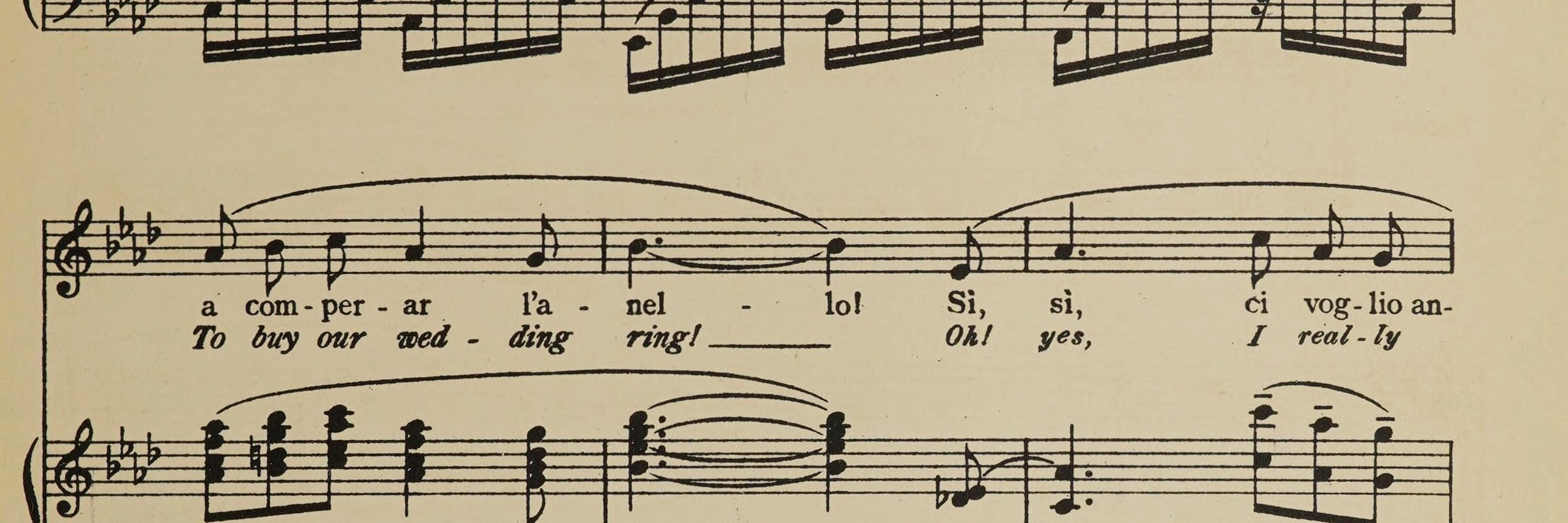
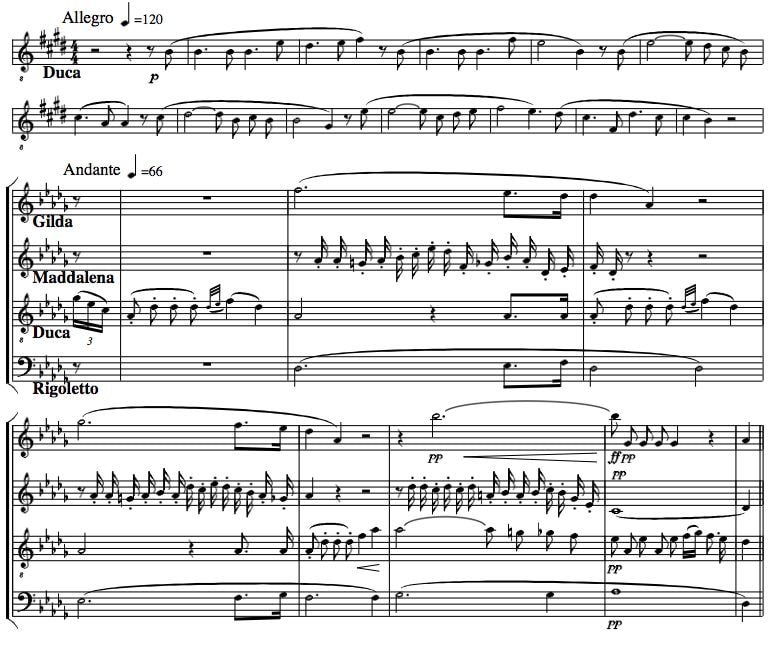
The Duke — Beautiful daughter of love —
Maddalena — He says that to everyone.
Gilda — So this is what he is.
Rigoletto — Weep no more. I have arranged it.
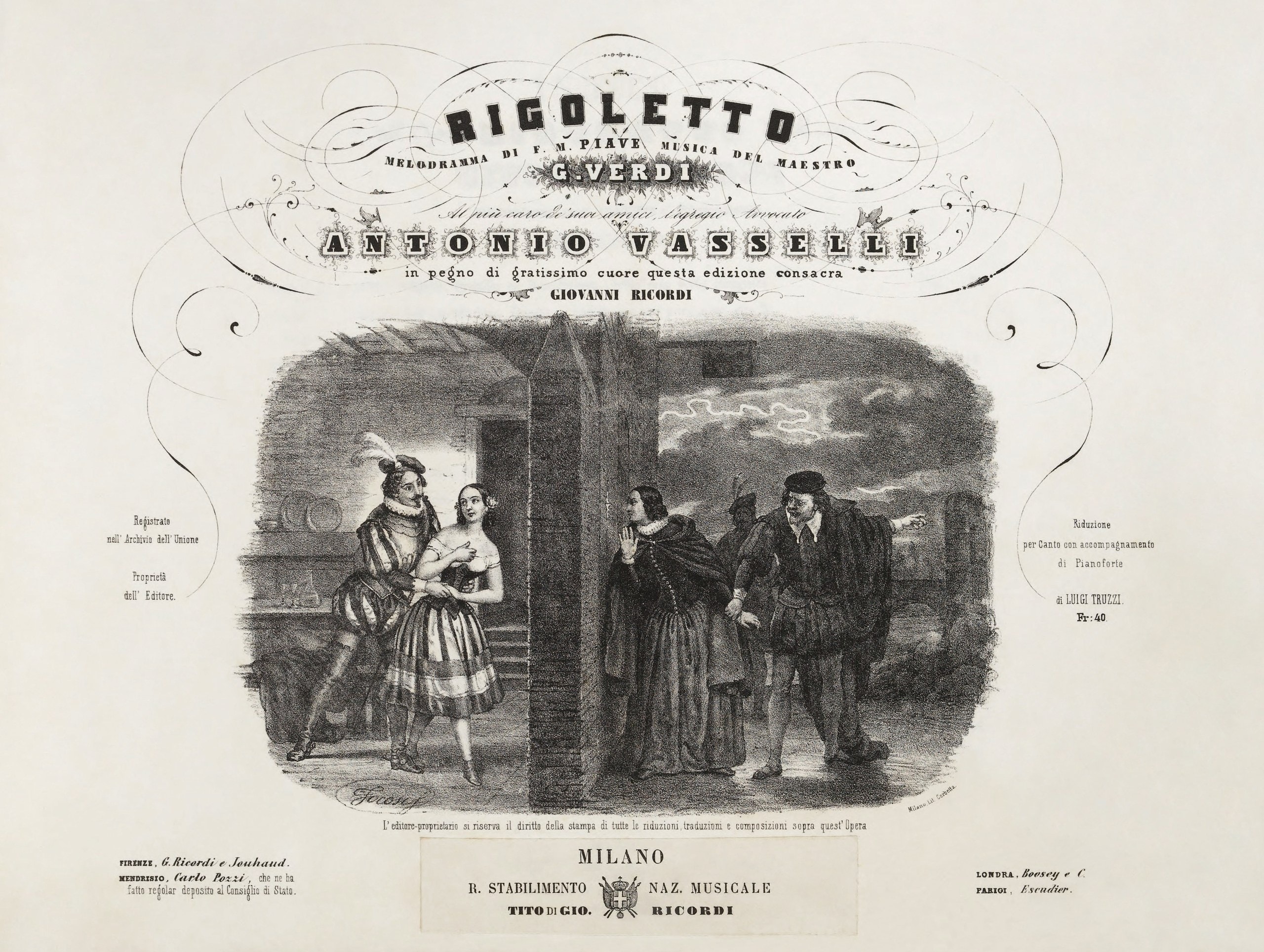
Venice, La Fenice, 11 March 1851. In the third act of a new opera called Rigoletto, four people sing at the same moment. A duke is seducing a woman he has just met. The woman is laughing at him and enjoying it. Outside in the dark, a girl watches the man she loves prove exactly what her father said he was. And beside her, her father is already planning a murder.
Four people, four completely different things, all at once — and the audience follows every one of them.
Victor Hugo wrote the play the story came from. He is reported to have said that if he could make four characters speak simultaneously and still be understood, he would have achieved the same effect. He could not. Sentences take turns.
That is the shortest honest answer to the question people ask when they hear the word opera: why do they sing instead of just telling us? Speech can be piled up — actors interrupt each other, films cut between rooms — but put those same four people on a stage speaking their thoughts at the same moment and nobody in the audience could tell you afterwards what any one of them wanted. Sung, on four separate melodic lines, all four arrive. The ear can hold what the ear can distinguish.
An accident in Florence
Opera is not much more than four hundred years old, which makes it younger than most people assume and a great deal younger than most of the theatre traditions alive in this country.
It began as a scholarly mistake. In the last decades of the sixteenth century a group of Florentine intellectuals, poets and musicians — later called the Camerata — became convinced that ancient Greek tragedy had been sung rather than spoken, and set out to reconstruct it. Their reconstruction was almost certainly wrong. What they produced instead was a new way of writing for the voice: a single line, following the rhythm and stress of speech, over a simple accompaniment.
The first result was Dafne, staged in Florence at the end of the 1590s; the music survives only in fragments. Euridice followed in 1600 and is the earliest opera we still have complete. Then, in Mantua on 24 February 1607, Claudio Monteverdi’s L’Orfeo — one of the earliest operas still regularly performed by professional companies.
“They set out to restore something ancient and invented something that had not existed.”
They set out to restore something ancient and invented something that had not existed. That is a fairly ordinary way for art forms to begin.
Everyone built their own
What happened next is the part that interests me most as a director. The form did not spread as a single Italian product. Wherever it arrived it was rebuilt locally, in the local language, with local rules about when people speak and when they sing.
German-speaking theatres developed the Singspiel, where spoken dialogue alternates with musical numbers — the tradition that produced Mozart’s Die Zauberflöte in 1791. France, under Lully from 1673, built the tragédie lyrique, formal, declamatory and inseparable from dance. England answered with the ballad opera: John Gay’s The Beggar’s Opera of 1728 set satirical words to tunes the audience already knew by heart, which is a strategy that has never stopped working.
And the instinct behind all of this — that a story is carried further by music than by speech alone — is obviously not a European invention. Working here, the thing that strikes me is not the resemblance but the specific difference.
In Yakshagana, the Bhagavata sings the narrative and holds the performance together from inside it; the actor on stage dances and speaks, but the singing voice is not his. Kathakali makes the same division: the vocalists sing, the actor’s face and hands carry the meaning. In opera the singer is the character, which means the physical instrument doing the acting is the same one producing the sound, and everything difficult about opera follows from that single condition. Marathi Sangeet Natak, which emerged in the nineteenth century, brings the two systems closest: there the performers sing their own roles.
None of this makes one form a version of the other. It makes the comparison worth having.
Before it was heritage, it was an industry
The most misleading thing about opera today is the building. Marble, chandeliers, dress code, hush. For most of its history opera was a commercial business with deadlines, and it behaved like one.
“Before it was heritage, it was an industry.”
The turning point was 1637, when the Teatro San Cassiano opened in Venice as the first public opera house where anyone with the price of a ticket could walk in. Opera left the private courts and entered a market. Venice ran seasons — Carnival from 26 December, plus autumn and spring — and each season wanted new work. Across the seventeenth century the city supported around nine or ten commercial opera houses, not all at the same time, and premiered well over a hundred and fifty operas.
That pace explains figures which otherwise look impossible. Alessandro Scarlatti is credited with something over a hundred operas, of which roughly half survive. He could work at that speed because the system was industrial: standard forms, extensive self-borrowing, and the pasticcio — an evening assembled from arias by several different composers, sold without embarrassment.
The composer, in that system, was rarely the most powerful person in the room. Power sat with the impresario who financed the season, with the librettist whose text might be set by thirty different composers, and above all with the star singers. In August 1737 Farinelli, the most famous castrato of the century, entered the service of the Spanish court, stayed roughly twenty-two years and never sang in public again — a career decision available only to someone who could afford to disappear. The screaming, the ticket speculation, the fan cults: all of it existed three hundred years before anyone invented the word fandom.
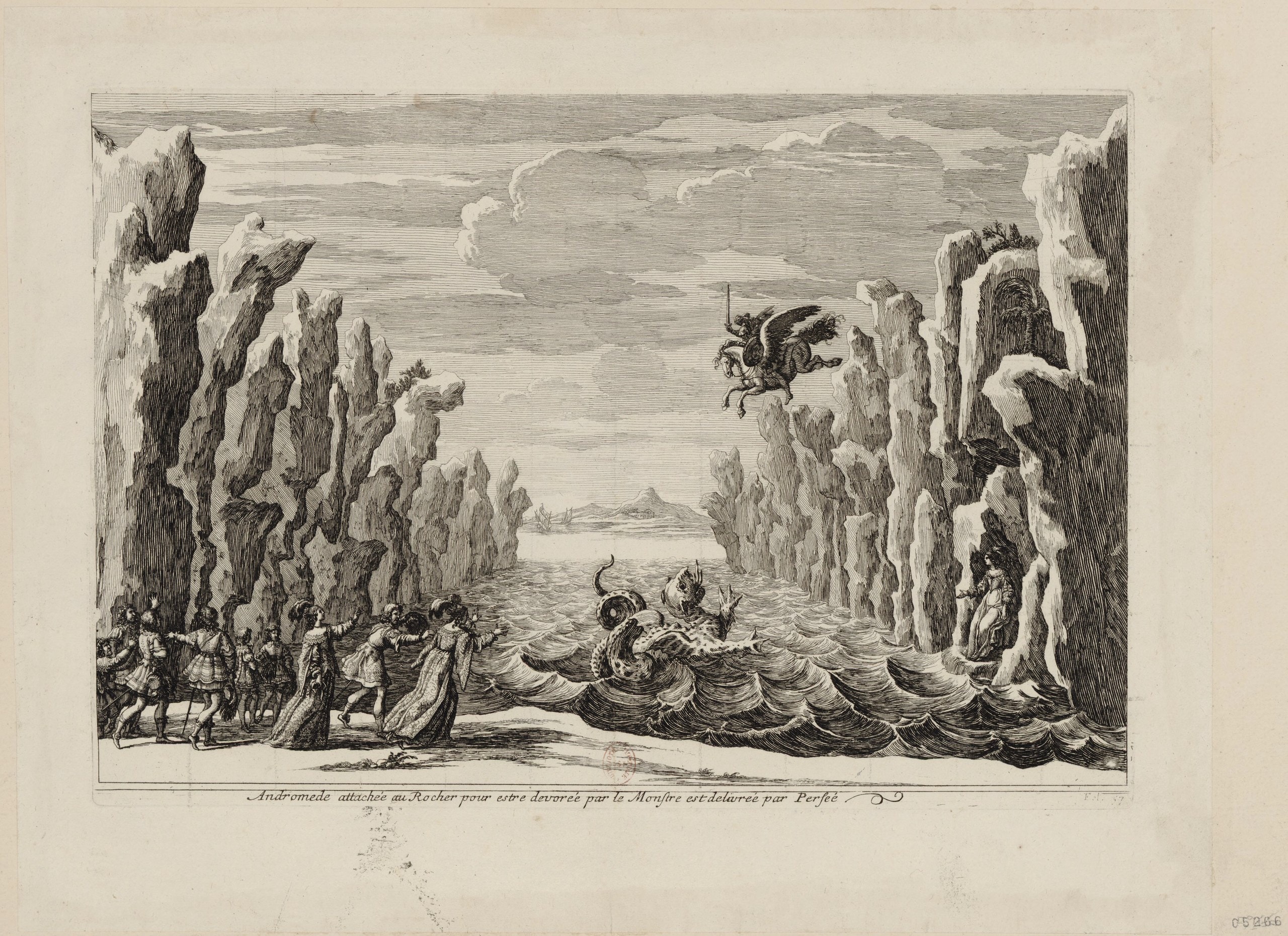
Opera also drove engineering. From 1641, at the Teatro Novissimo in Venice, Giacomo Torelli — nicknamed il gran stregone, the great sorcerer — linked every piece of scenery to a single winch below the stage. One operator, one movement, and the entire world on stage changed in seconds. Audiences came for the machines the way audiences now come for the effects.
The argument that never ended
There is one question the form has been arguing with itself about since the beginning, and it has never been settled: in an opera, who serves whom — the words or the music?
On 7 February 1786, in the Orangery of Schönbrunn Palace, Emperor Joseph II staged an evening of two short works at once. At one end, Antonio Salieri’s Prima la musica e poi le parole — “first the music, then the words”. At the other, Mozart’s Der Schauspieldirektor. Mozart had already given his own answer in a letter to his father on 13 October 1781: in an opera, he wrote, the poetry must be the obedient daughter of the music.
Gluck had argued the exact opposite. The preface published with Alceste in 1769 — signed by Gluck, probably drafted by his librettist Calzabigi — demanded that music be restricted to its true office of serving the poetry, and threw out the ornamental machinery singers had been using to interrupt drama for decades. Richard Strauss was still writing operas about the question in 1942, and still declining to answer it.
“I would call it the reason both answers keep being right.”
I would not call that a failure. I would call it the reason both answers keep being right.
I have worked in both worlds — in operetta and musical theatre, where the dialogue is spoken, and in opera, where it is not. Singing opera has always been the easier acting job for me, and not because singing excuses you from acting. It is because the intonation has already been decided. A serious composer knew the language he was setting, knew what the line meant, and built the emphasis into the notes; by the time you open your mouth, half the interpretative decisions are made and they are better than the ones you would have made alone. Mozart set his Italian operas — Le nozze di Figaro, Don Giovanni — in a language that was not his own, and still knew exactly which syllable had to be carried and which could be thrown away.
That is Mozart’s obedient daughter, and in an aria he is right. In recitative he is not. Recitative exists to move information, and there the words take the argument back.
Which may be why the quartet is the best answer anyone has given. Four texts, four melodies, nobody serving anybody.
What opera dragged along behind it
Because it needed everything, it developed everything.
It shaped buildings: the horseshoe auditorium ringed with boxes, the proscenium arch, and eventually Wagner’s Bayreuth in 1876, which hid the orchestra in a sunken pit and put the audience in the dark — an arrangement any cinema-goer will recognise. It fed on literature and paid it back, sending audiences to Hugo, Schiller and Shakespeare through Verdi. It kept ballet inside the French repertoire by law of custom.
And it helped produce the first scientific view of the living singing voice. Manuel García the younger, a singing teacher, wanted to see what his students were actually doing. In September 1854 he used mirrors and daylight to look into a working larynx, becoming the first person to observe a living glottis in the act of singing; his paper reached the Royal Society the following year. That experiment became one of the foundations of modern laryngology — and it began with a voice teacher trying to solve a teaching problem.
So is it dying?
The honest answer is that the numbers are uncomfortable and the conclusion is not obvious.
The Metropolitan Opera sold 72% of its capacity in the 2024–25 season, below its own target. Subscriptions there have fallen to about 7% of ticket sales, from 12–15% before the pandemic — the audience that used to commit to a whole season in advance is disappearing. That is real, and pretending otherwise would be silly.
Now the other column. The average age of a single-ticket buyer at that same house was 44, down from 50 before the pandemic; the audience is not only shrinking, it is also getting younger. Germany alone funds 83 opera houses and accounts for roughly a third of recorded opera performances worldwide.
And in India there is a small, real, growing scene: the Royal Opera House in Mumbai restored and reopened in 2016; fully staged productions at the NCPA with the Symphony Orchestra of India; the Neemrana Music Foundation staging opera in Delhi since the early 2000s.
Then there is the evidence closest to hand — and it starts with a building. Bangalore had an opera house, on Brigade Road, built under the British and busy in its day. It went dark, fell into disrepair, and was eventually restored by Samsung as a mobile experience centre. The colonnades are still there, and so is the stage, framed by its classical columns. Nobody sings on it.
“Seventy years is long enough for a form to be declared finished. It is not long enough for it to stay that way.”
That is what seventy years looks like from the outside. On 23 and 24 February 2024 the Department of Western Music staged Sullivan’s Trial by Jury — a one-act courtroom comedy with no spoken dialogue at all, directed by Ajna Sultana, with Vrinda Vinod conducting the chorus and Anastasiya Yafimava at the piano, under my artistic direction. The university records it as the first opera performed in Bengaluru in more than seven decades. Eleven months later, Purcell’s Dido and Aeneas was staged at the Bangalore International Centre.
Seventy years is long enough for a form to be declared finished. It is not long enough for it to stay that way.
What has genuinely changed is the job. A singer today is expected to be a complete stage animal: to sing, to move, to speak a line cleanly, to hold a character while doing all three. A voice on its own is rarely enough now, and the competition for the work that exists is severe. The compensation is that the boundaries between the forms have thinned. A properly trained singer who can act is now employable in opera, in operetta and in musical theatre — each has its own dialect, and one instrument speaks all of them.
Which is also what a room can be. Studio 706 is a rehearsal room in the music department, and over the past two years it has held the Trial by Jury rehearsals, a conducting masterclass, and the South Asian Symphony Orchestra, which was given a rehearsal base there before its concert at CHRIST on 2 August 2025, where our own students and graduates appeared as conductors and as singers in the concert choir. The orchestra had played the main auditorium here before. Nothing about 706 is grand. That is rather the point.
Trial by Jury — full performance
CHRIST University · February 2024
Where it actually lives
Funding keeps a form available. It does not keep it alive. What keeps it alive is the number of rooms in which somebody is currently trying to do it and not yet succeeding.
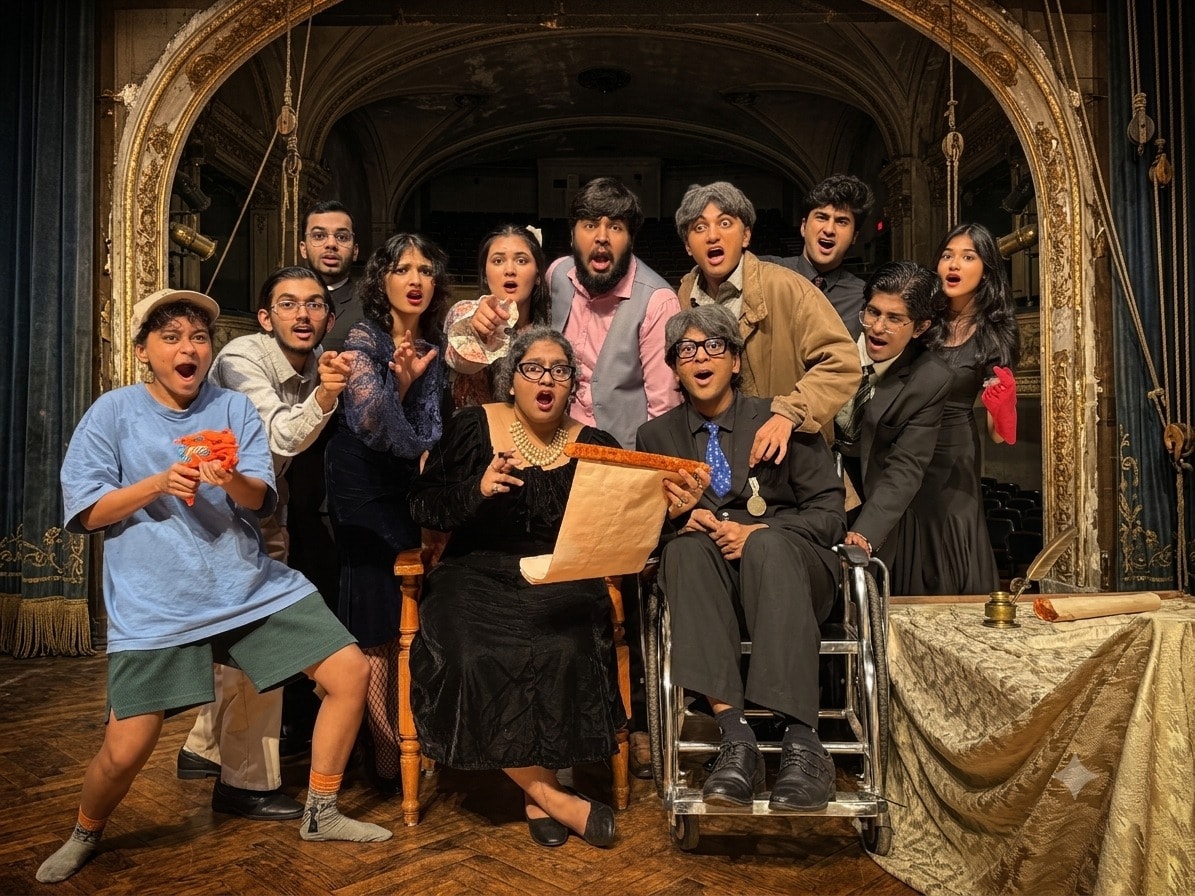
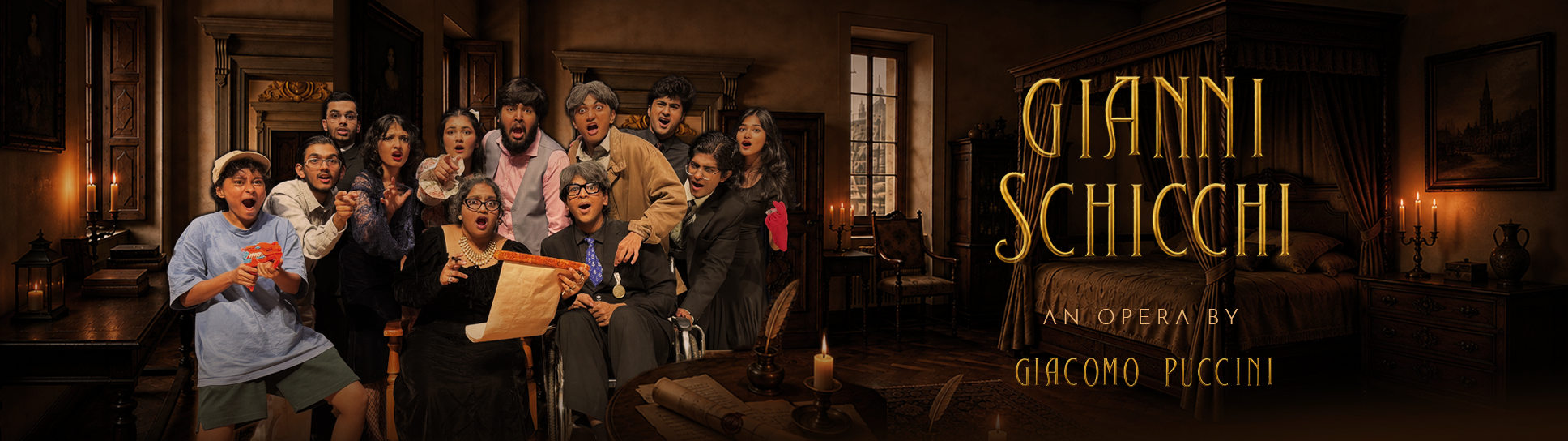
Which is the part I would ask you to notice. In 706, this month, a group of students is learning to make Puccini’s comedy land in English, against a track that does not wait for anybody. Whether opera is alive in the world is a question for statisticians. Whether it is alive in this building is a question with a date on it.
Andrey Morozov is a baritone, stage director, conductor and educator at CHRIST (Deemed to be University).