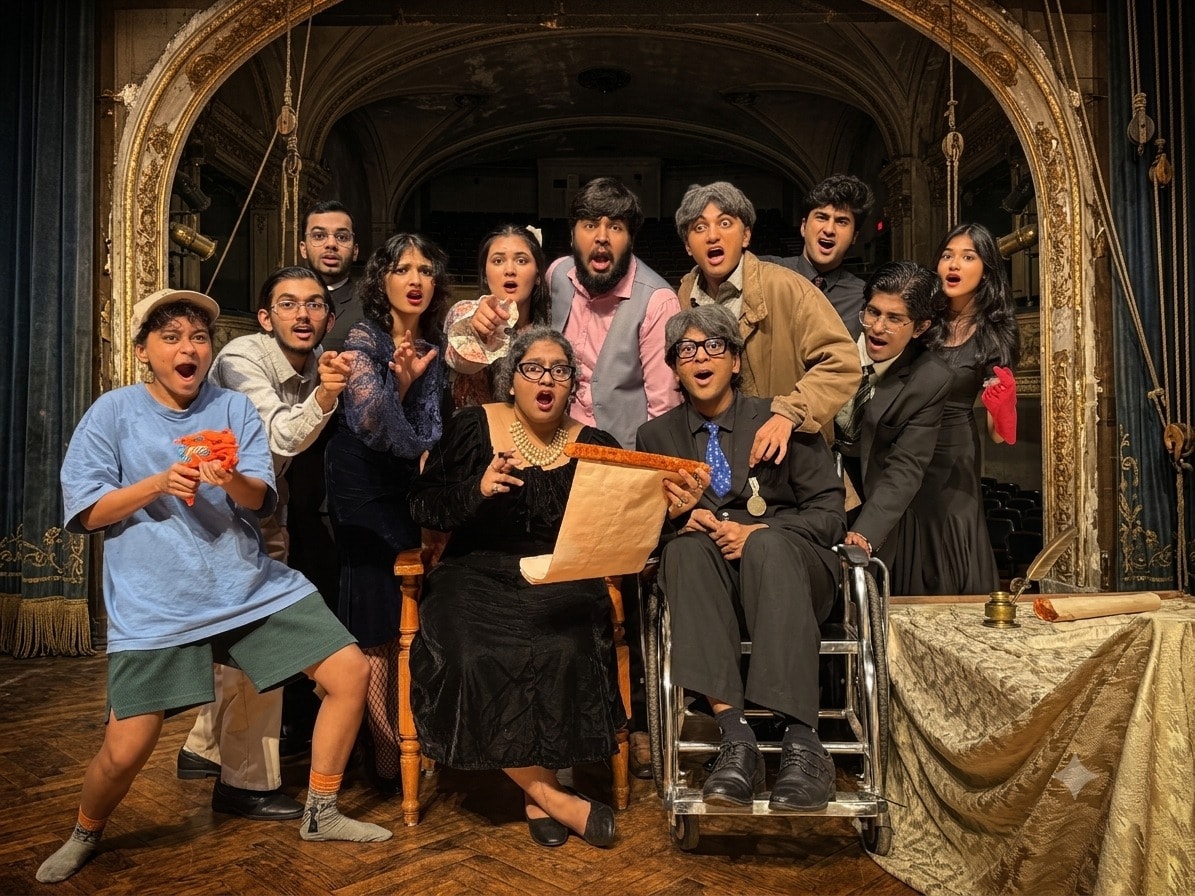
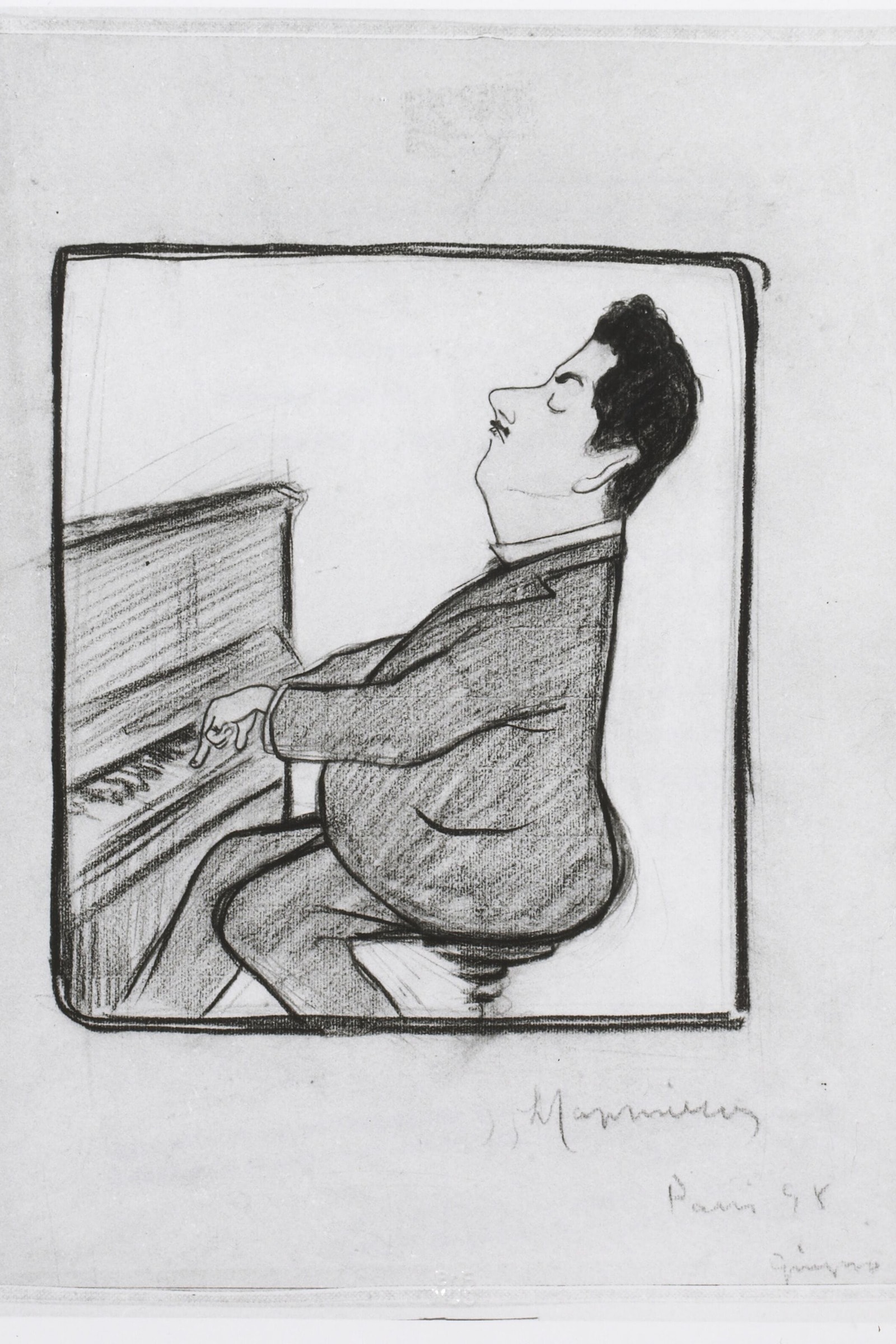
Every opera has two lives. One happens on stage, in front of you, in an hour. The other happens for months before that, in rooms nobody visits, and it is usually never mentioned.
This is a piece about the second one. About the music — how the orchestra of Gianni Schicchi came to exist for our production, and why the way we made it changes what our singers have to do.
“Every opera has two lives.”
What Puccini Actually Asked For
Let us begin with the score, because the score is not modest.
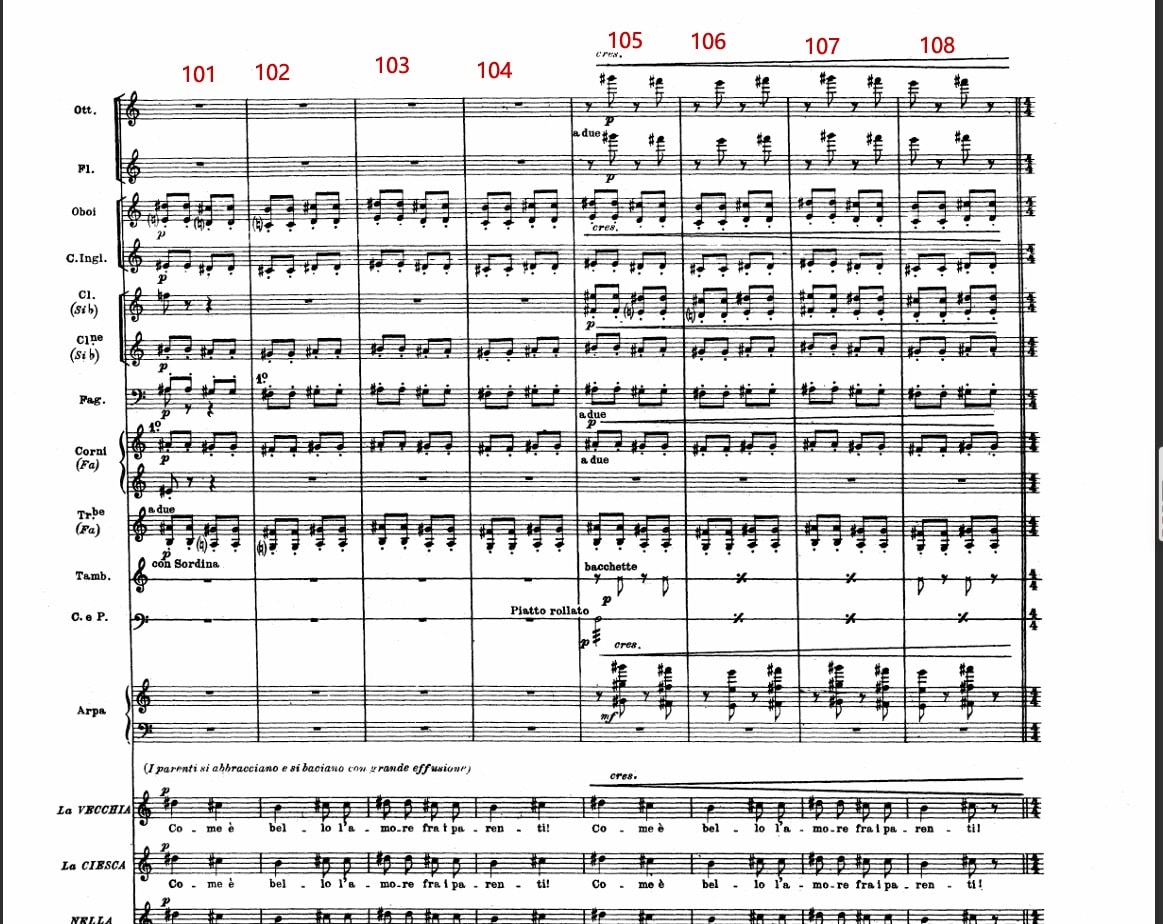
For this one-hour comedy, Puccini asks for approximately sixty orchestral musicians: piccolo, two flutes, two oboes, cor anglais, two clarinets, bass clarinet, two bassoons. Four horns, three trumpets, three trombones and a bass trombone. Timpani, triangle, side drum, bass drum, cymbals. A harp. A celesta. Full strings. And, offstage, a church bell.
He wrote all of that for a comedy about a family arguing over a will.
That instrument list is not decoration. Puccini used it with a particular technique worth knowing about before you hear the opera, because once you notice it you cannot un-notice it.
The Thing Puccini Does
Most nineteenth-century Italian composers before him — Bellini, Donizetti, and much of Verdi — kept the orchestra politely underneath the singer. Support, not competition.
Puccini does something else. At the emotional peak of a melody, he takes the vocal line and doubles it in the orchestra — the same tune, played by the strings in unison with the voice, or an octave below, or above. The voice is no longer alone; it is suddenly forty people wide.
This is why a Puccini melody hits the way it does. It is not only the tune. It is the moment the orchestra stops accompanying and starts singing the same thing you are singing.
There is a second thing, and it matters even more for us. Puccini writes music that does not stop.
In older operas there is a clear alternation: recitative (sung speech that carries the plot forward, lightly accompanied), then aria (the emotional response to what just happened, in strict time). Stop, start, stop, start. In Puccini that division is largely gone. The music runs continuously from the first bar to the last, and the arias grow out of the conversation instead of interrupting it. A trained musician can find the seams. A listener usually cannot.
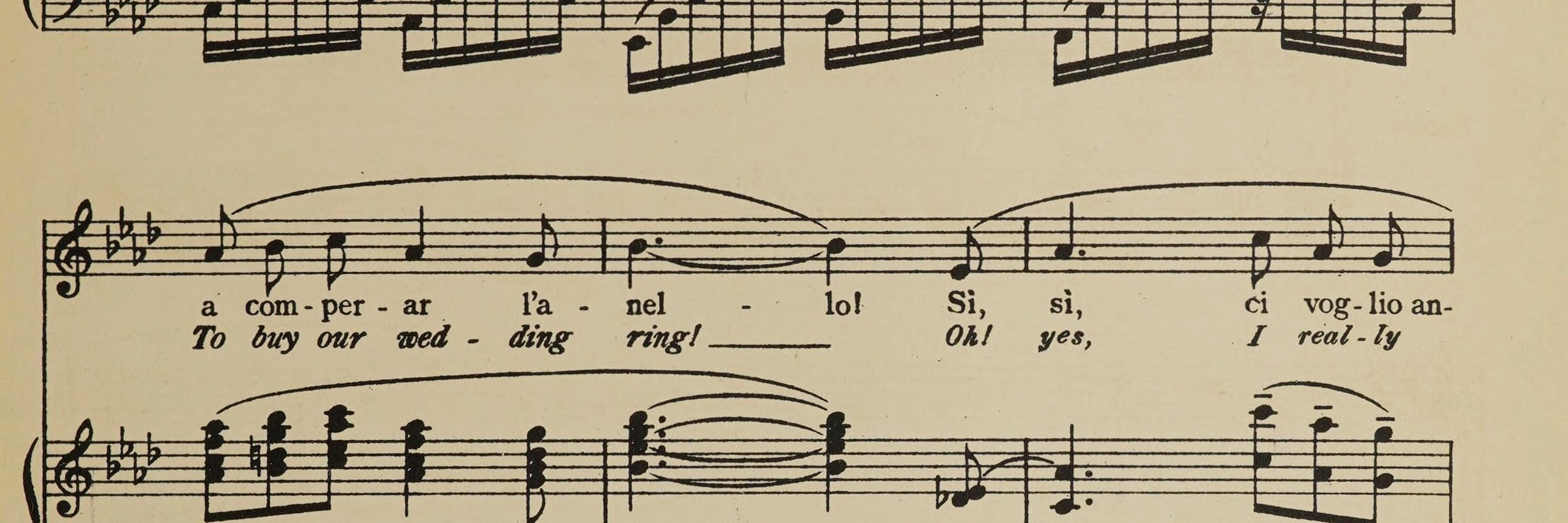
O mio babbino caro is the perfect example. It arrives without warning, in the middle of an argument, and disappears back into the argument afterwards. Nobody stops for applause. The story simply keeps moving.
“The voice is no longer alone; it is suddenly forty people wide.”
Why Not Simply Use a Piano?
It is a fair question, and for our previous productions that is exactly what we did. It would also have been the far easier path here. There is nothing wrong with it: it is how opera has been rehearsed and studied everywhere for two hundred years, every note is audible, and a great many university productions work this way, understandably, when a live orchestra is not within reach. It remains one of the foundations of opera education.
But Puccini did not compose for a piano.
He composed colours. He composed instrumental dialogue — a mocking figure in the woodwinds, a false solemn chord in the brass, the celesta glittering behind a line of conversation. He composed dramatic timing that lives inside the orchestra itself, in the space between one instrument answering another.
On a piano, all of that becomes one colour.
Why we chose this approach — we wanted our audience to hear not only Puccini’s melodies, but Puccini’s orchestral imagination.
In Gianni Schicchi the joke is very often in the orchestra rather than in the voice. A piano reduction tells you the joke exists. It cannot tell it. We wanted our audience — many of whom will be attending their very first opera — to experience not simply the melodies, but the orchestral world Puccini imagined.
So for this production the orchestral score has been prepared as a computer-realised orchestral track, made specifically for us, in our own university studio.
Building It
The word “track” can be misleading, so let me describe the process honestly.
Nothing was taken from an existing pre-recorded backing track. Everything was prepared directly from Puccini’s orchestral score.
I worked from the full score and entered it bar by bar — every instrumental line, every marking — into music software. That part is slow, but it is the straightforward part.
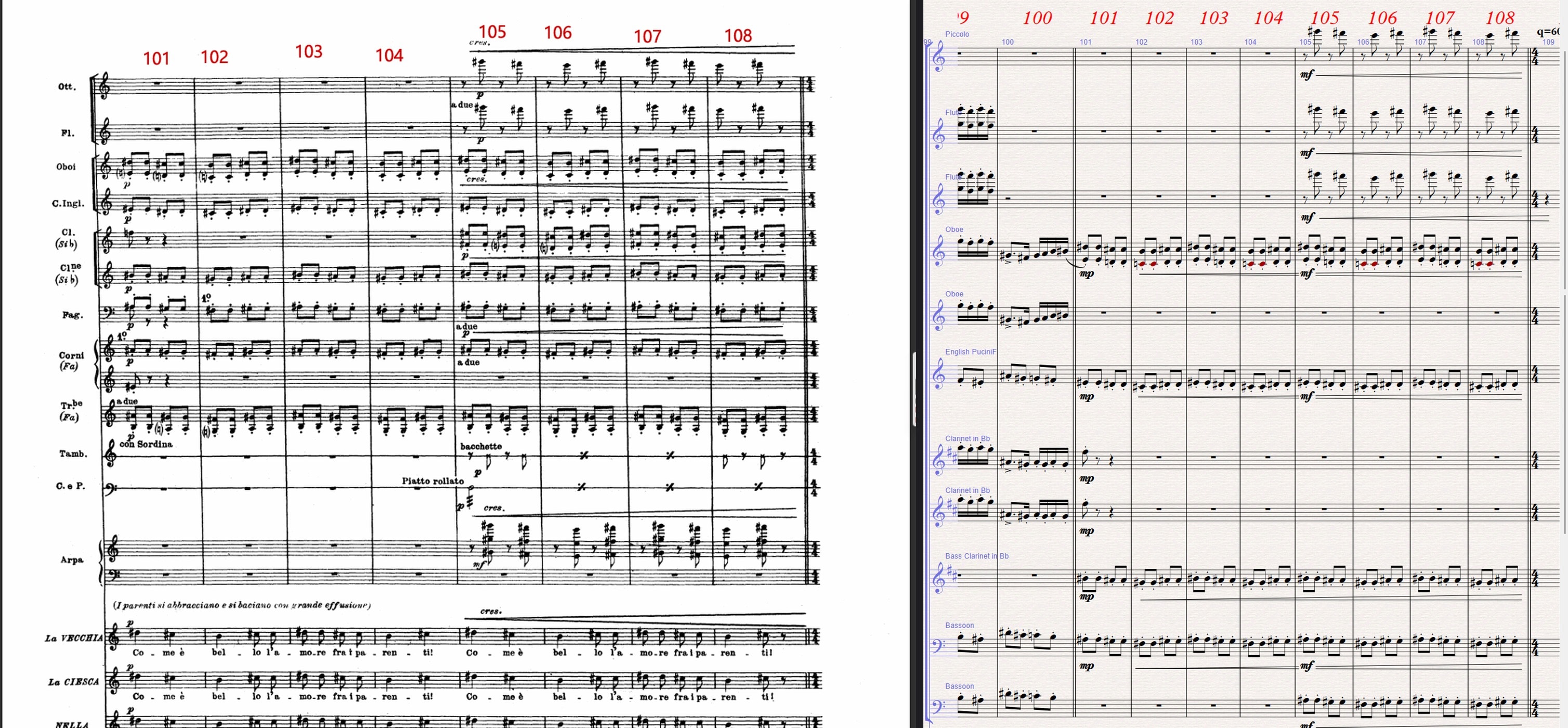
Entering the notes was only the beginning. Every instrument then had to be given its proper musical character.
Strings do not simply play notes. They alternate between legato and staccato (smoothly connected, or short and detached), between passages played with the bow and passages plucked with the fingers (pizzicato), with and without mutes fitted to the bridge (con sordino and senza sordino), with accents, with dynamic shaping, and with constant changes of articulation from one bar to the next. Woodwinds and brass need their own phrasing, their own attacks, their own colour. Every one of these decisions had to be programmed individually, note by note, so that each instrument would respond the way Puccini intended.
Only then does a score begin to sound like an orchestra rather than a collection of correct pitches.
People often imagine that computer-realised orchestration is a matter of pressing “play”. In practice it is much closer to orchestration itself. The notes are the skeleton. Articulation, phrasing, dynamics, tone colour and timing are what make it music.
“The notes are the skeleton. Articulation, phrasing, dynamics, tone colour and timing are what make it music.”
Then came the most time-consuming part: choosing and shaping sampled instruments (recordings of real players, organised so they can be performed from a keyboard) until the result resembled a live orchestra as closely as we could get it. Some passages required days rather than hours.
And even with every note entered, every articulation chosen and every tempo settled, the work was not finished. What follows is mastering: balancing the whole orchestra, adjusting the colour and the perspective of each section, deciding how near or far each orchestral section should sound within the orchestral image, and making certain the music stays clear and dramatically alive from the first bar to the last.
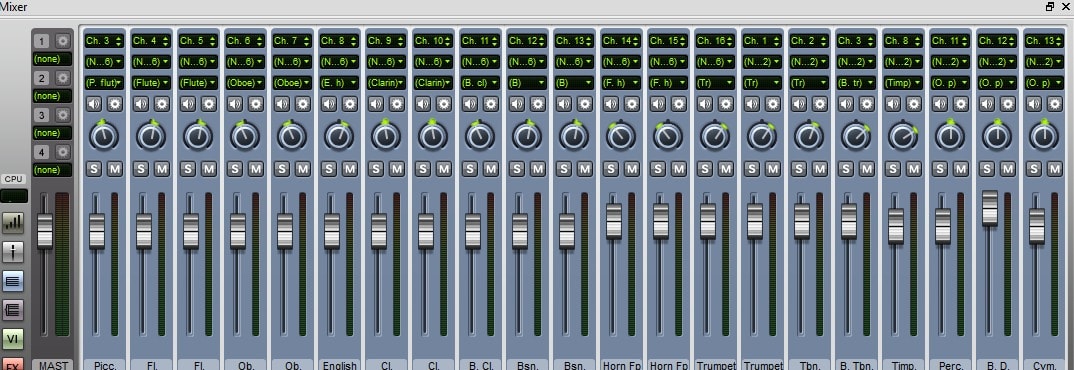
“A single convincing minute can take many hours to produce.”
Which is why a single convincing minute can take many hours to produce. Our production contains almost an hour of music. The audience will experience it as one continuous musical story, which is exactly right — but it is worth knowing what sits underneath it.
Anastasiya Yafimava, our répétiteur, continues to work with the singers at the piano throughout the rehearsal period. The piano has not gone anywhere. It is where the roles are actually built. The realisation is what the roles are built towards.
The Hard Part: Puccini Refuses to Sit Still
Here is the real difficulty, and it is specific to this composer.
If you were preparing a track for Mozart or Haydn, most of an aria would move at one steady speed. You could almost set a metronome and leave it.
Puccini does not work like that. His pages are covered in instructions to bend the pulse — rit. (slow down), accel. (speed up), rubato (stretch and compress the beat expressively), fermata (hold this note or chord for as long as the moment needs), a tempo (back to normal). Sometimes several within a single line of text. The flexibility is not ornamental. It is where the emotion lives.
In a normal performance a conductor negotiates all of this live, breathing with the singers. Some nights the phrase is a little slower. Some nights the pause is a little longer. That is what a conductor is for.
A prepared orchestral track cannot negotiate with a singer. Every ritardando, every acceleration, every fermata has to be imagined, tested, refined and fixed long before the audience enters the hall.
I know exactly how that feels from the other side. For about eight years I performed a one-man opera at the Philharmonic Hall in Minsk, once or twice a month, always to a prepared orchestral track. And the strange thing is this: some evenings the track felt fast. Some evenings it felt slow. It was, of course, identical every single time. What changed was me — my breathing, my nerves, the room, the audience. And I had no way to ask it to wait.
That experience is one of the reasons I approached this production the way I did. Learning to live inside a fixed musical structure is a genuine skill, and it has to be trained like any other.
Learning It Slowly First
Which brings me to something that makes the whole method work, and that did not exist when I was doing this in Minsk.
There is now rehearsal software that plays back a complete orchestral realisation at any speed you like, slower or faster, without changing the pitch. It sounds like a small technical convenience. In a rehearsal room it changes everything.
Consider what a student is actually being asked to do in this opera: sing accurately, in a foreign musical language, in overlapping ensembles, at conversational speed, while moving around a crowded stage and acting a character. Attempting all of that at full performance tempo from the first rehearsal does not build skill. It builds panic.
So we do not start there. We start slower — sometimes considerably slower — and build the rhythm, the ensemble coordination, the diction and the staging at a speed where everything can be heard and corrected. Then we creep back up towards Puccini’s tempo over the following weeks.
Here is the part that matters most, and it is the reason we do this with the orchestral realisation rather than the piano. Slowed down, the orchestra is still entirely there. Every timbre, every counter-melody, every instrumental joke, every entrance the singers need to hear. The students are learning the actual sound world of the piece from the very first rehearsal — just at a speed they can absorb. A piano at half tempo teaches you the notes. An orchestra at half tempo teaches you the opera.
I would recommend this to anyone working with prepared accompaniment, in any repertoire. The particular application matters far less than the principle.
“A piano at half tempo teaches you the notes. An orchestra at half tempo teaches you the opera.”
“Building the ensemble at a speed where everything can be heard.”]
Can a Prepared Orchestra Breathe?
The standard objection to this way of working is that a fixed realisation cannot respond to a singer the way a living conductor can. There is real truth in that, and I am not going to pretend otherwise.
But the opposite is also true, and it is less often said. In professional opera, even a live conductor does not always follow every impulse of every singer. Whether they can depends on the conductor, on the orchestra, on how many rehearsals everyone was given, and on a dozen other things that have nothing to do with the singer’s intention on the night. I have spent twenty years finding this out.
Real operatic interpretation has never been one person’s spontaneous will. It is an agreement — negotiated between conductor, orchestra and soloists over weeks of rehearsal, long before an audience is in the building.
Our process is the same shape. We begin at the piano and find the natural dramatic flow of each scene together with the singers: where a phrase wants room, where the comedy needs to accelerate, where a silence has to be longer than it looks on the page. Only then is the orchestral realisation shaped around the decisions we made together.
After that, yes — it is fixed. But it was never arbitrary. Every tempo in it is a decision somebody made in a rehearsal room, with the singers in front of them.
Who Conducts When There Is No Conductor?
Because we perform without one, someone still has to do the conductor’s remaining job: knowing precisely where we are in the music at every moment.
That responsibility belongs to Malvika, our assistant director. She follows the full score in performance and starts and stops each track at exactly the right instant. This sounds simple. It is not. Gianni Schicchi is full of long held chords, sudden silences, and changes of metre (the number of beats in a bar — Puccini changes it constantly). A cue that arrives half a second early is audible to everyone in the hall.
We have also made one deliberate adaptation, and I would rather explain it than have someone notice it and wonder.
In a few places we have added quiet musical cues to the realisation — a bell, an extra drum stroke, a chord repeated rather than held — at moments where Puccini gives the singers nothing audible to measure against. An attentive listener may catch one or two and wonder what they are. They are not Puccini. They are us, helping eleven people breathe together at the same instant.
Why This Is Good For the Singers
There is a version of this article where all of the above sounds like a compromise. It is not, and I want to be clear about why.
When a conductor is present, a singer who drifts gets caught. The orchestra follows, the tempo adjusts, the mistake disappears. That safety net is a wonderful thing — and it can also hide a great deal.
With a fixed realisation there is no net. The music does not wait, does not adjust and does not forgive. In an opera like this one, where nearly a dozen people sing rapid overlapping ensembles, one singer who rushes will pull three others with them within two bars.
So the discipline this demands is absolute — and it teaches something genuinely difficult to teach any other way: you are not the centre of this. The music is. However strongly you feel a phrase tonight, your job is to live inside the score rather than in front of it.
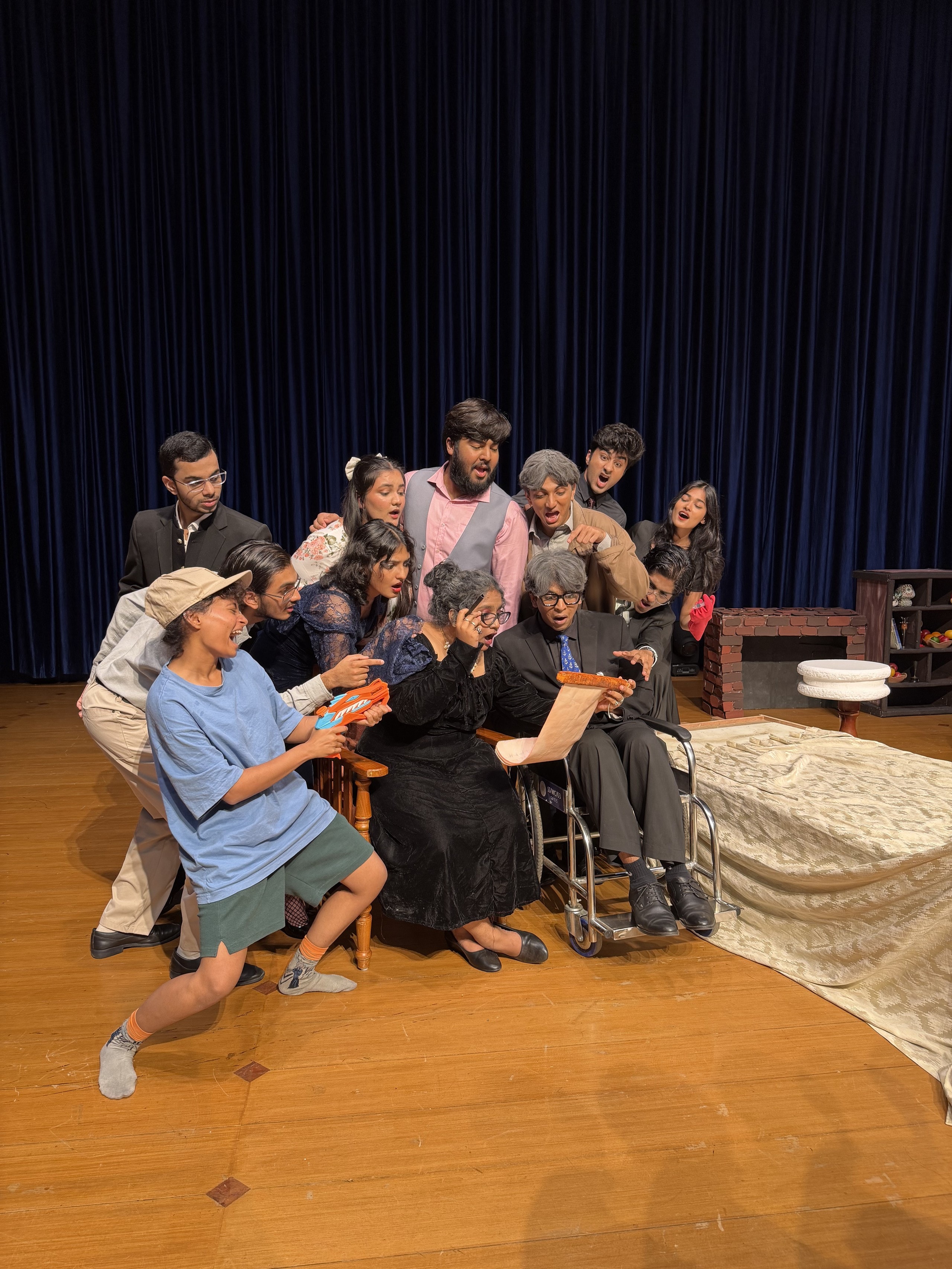
Our performers are, for the most part, students — from the Department of Music, alongside students from the Department of Theatre working on the production. For most of them this is the first time carrying a principal role in front of a paying audience. After a season of working like this, standing in front of a living conductor who breathes with them and catches them when they fall will feel like an enormous luxury.
That is what a university production is for. Not only to put on a show, but to send people out able to do things they could not do in June.
“You are not the centre of this. The music is.”
Coming Next
We will take you further into the rehearsal room over the coming weeks — the staging, the ensemble work, our dancers, whose role we are still keeping secret, and the singers themselves.
- 🎭 Stage Direction
- 🎼 Ensemble Rehearsals
- 💃 The Secret of the Dancers
- 🎤 Meet the Cast
If you would like to see where all of this is heading, the production page is here: Gianni Schicchi. And if you would rather simply be told when something new appears, leave us your email — we will not send you anything else.
Most of our audience will never notice a single thing described in this article. And that is exactly as it should be.
If they laugh in the right places, if Puccini’s melodies carry them through the story, and if they walk out believing they have simply seen a wonderful opera — then every hour spent on every orchestral line will have done precisely what it was meant to do.
The best technical work is the work nobody in the hall ever has to think about.
“The best technical work is the work nobody in the hall ever has to think about.”
For this production we used Transcribe!, though similar tempo and pitch functionality exists in a number of rehearsal applications. Photographs from the studio and rehearsal room will be added to this article shortly.