


Gianni Schicchi at CHRIST University: Six Voices Meet Opera for the First Time
Backstage series · 03 · Six first operas inside one quarrelling family
Six of our singers meet opera for the first time in Gianni Schicchi - an old man in a wheelchair, a graduate who came back to sing, and two young performers who have to make an audience believe in love while the plot is being rewritten around them.

A rich man has died. His relatives are gathered around the bed, and for a few moments grief appears to be the principal business of the room.
Then somebody mentions the will.
From that point Puccini gives the Donati family very little opportunity to behave well. They interrupt, calculate, accuse, bargain, whisper, shout and — when necessary — sing several different thoughts at exactly the same time.
That last point matters. Gianni Schicchi is a comedy, and comedy does not make the work easier. A tragic gesture can survive being slightly too large. A comic one depends on timing: the entrance, the glance, the pause, the person who reacts half a second too late. The singer has to produce the note, hear several other lines, remember the staging, and still let the audience understand why any of it is funny.
Six singers live inside that room: Sahana Shajitha Begum as Zita, Ray Paul Manoj as Simone, Meghna Bindu as Nella, Sparshan Ganguli as Rinuccio, Helen Elizabeth Samuel as Lauretta and W. Sahithi as La Ciesca.
They are not the whole family. Sixteen performers appear in our Gianni Schicchi — Schicchi himself, the notary, the doctor, the boy, the rest of the household, each with an evening of their own to get through. This instalment of Backstage takes six of them. The others will have their turn before the premiere.
For all six, this is a first opera. They have not arrived at it from the same place.
Sahana Shajitha Begum — Zita

Zita is Rinuccio's aunt and one of the strongest personalities in the family. She knows what she wants, has opinions about everyone in the room, and no difficulty making them audible.
That makes the casting interesting. Away from the stage Sahana is courteous, restrained and considerably softer than the woman she plays. Zita has to command — she interrupts, insists, judges, and becomes deliberately unpleasant when the family stops behaving as she thinks it should.
Finding that authority has been the work: not merely singing the role correctly, but occupying more space, taking control of an exchange, letting the character become harder than the performer.
Sahana also builds. In rehearsal she proposes gestures and solutions rather than waiting for every detail to be supplied. Some ideas stay, some disappear. That is exactly how rehearsal should work.
Ray Paul Manoj — Simone

Simone is one of the senior men of the family, a former mayor of Fucecchio, and a man who clearly believes this should still count for something. The rest of the Donatis are not interested.
Gianni Schicchi is Ray's first opera, but not his first time on this stage. Last year, in My Fair Lady — the second of our two runs of it, four performances in the same KE Auditorium where we now play — he was asked at short notice to take over the role of Freddy from an actor who had left. There was no comfortable preparation. He had to learn the part, enter a production already in motion, and be believable inside it.
He was.
The two roles could hardly sit further apart. Freddy is a young man undone by love. Simone is an old man who expects deference and no longer receives it. Between them lies most of the range an actor is asked to cover.
Ray has since completed his bachelor's degree in the Music Department, and is now in the first cohort of a newly opened honours programme — a format still new in Indian higher education — where students work with faculty from the Theatre and Music Departments of CHRIST towards a deeper qualification as musical-theatre performers. More theatre, more acting, more of the craft that lives between the two disciplines. Alongside that, he has sung in our choral performances throughout.


There is also an arithmetic problem.
Simone has been telling this family what to think for decades. Ray is in his early twenties.
Sixty years have to be built rather than borrowed. Not a shaking voice and a bent back — that route produces a caricature inside thirty seconds. Age on stage is mostly a matter of tempo: how long a man takes before answering, what a turn of the head costs him, how completely he assumes everybody will wait.
Our staging adds a physical condition. Simone moves about the room in a wheelchair.
That is good for the comedy and inconvenient for the singing. A singer's instrument is the whole body: breath depends on how the ribs are carried, posture decides how much air is available and where the sound goes. Sitting already takes some of that away. Steering the chair yourself takes more, and a wheelchair behaves differently on a raked stage than it does in a rehearsal room.
Puccini does not lower his demands because a character is seated.
So Ray runs two jobs at once: hold an old man's weight and rhythm, and keep the breath of a young singer who still has to be heard across an ensemble.
Sixty years have to be built rather than borrowed.
Meghna Bindu — Nella

Meghna has already finished her studies in the Music Department, and crossed the line students spend years preparing to cross: music is now her profession. She works at CHRIST Junior College as a musician and choir director — responsible not for joining an ensemble but for organising one.
Then she comes back to rehearsal to become Nella.
There is a useful reversal in that. In her working day she is the person asking an ensemble to listen. In Gianni Schicchi she is one member of a family in which nobody wishes to listen to anybody.
She brings a beautiful soprano to the role, but another quality has proved equally valuable: Meghna thinks theatrically. She proposes movement, interaction, small pieces of business, rather than waiting for instructions. Not every suggestion enters the production. What matters is the question behind them — not what have I been told to do, but what is actually happening here.
She asks: what is actually happening here? That question is where acting begins.
Sparshan Ganguli — Rinuccio

If this group has an engine, it is Sparshan.
He performs, studies, and looks for places to test what he is learning outside the classroom; this year he was made a laureate of Alatone 2026, an international competition-festival, in the 17–22 voice category. He also brings something Rinuccio needs immediately: energy — occasionally rather more of it than a scene can hold. There are rehearsals in which the director's task is not to ask for more but for slightly less. That is a good problem. Energy can be shaped; producing it from nothing is far harder.
Vocally he has the full tenor range the part requires, and dramatically Rinuccio asks for the same forward drive. While the family calculates its share of Buoso's property, he is fighting for Lauretta and for Schicchi's acceptance into a household that does not want him. His aria, Firenze è come un albero fiorito, briefly widens that argument into a defence of Florence itself, and of the outsiders whose talent renews it.
But Rinuccio's harder work is not in the aria. He and Lauretta have to convince us they are in love — which sounds simple until two young performers must do it in front of other people.
He is also, as it turns out, the most experienced performer in this cast.
Before the opera there was My Fair Lady, staged twice — two performances in the first run, four in the second. Sparshan sang in both, with a different cast each time. Six evenings on this stage.
He played one of Doolittle's drinking companions: a working man with a glass in his hand, several streets and several social classes away from the drawing rooms the plot is busy with.


That matters more once it is set beside Ray's story. When Freddy had to be recast at short notice, Sparshan was the obvious candidate: the range was there and so was the acting. He was not moved. Nobody could replace what he was already doing, and he was too convincing in the part to be taken out of it.
Which leaves the two years sitting neatly against each other. Then he was a man with no property at all, drinking in a London street. Now he is a young man of a wealthy Florentine house, arguing for the right to marry the woman he wants.
Helen Elizabeth Samuel — Lauretta

Playing love on stage is difficult for experienced actors. In comedy it is harder still. Rinuccio and Lauretta cannot simply stand opposite one another and demonstrate affection; their relationship has to stay believable while the scene around them moves towards deception and an increasingly elaborate attempt to rewrite a dead man's will.
Lauretta is not merely the innocent girl standing beside a famous aria. She knows what she wants and whom she has to persuade — her father.
O mio babbino caro has travelled far beyond this opera, into recitals, recordings and films, often so far that listeners recognise every phrase without knowing who Lauretta is. Inside the opera it is not a display. It is an action: Schicchi must stop refusing and get involved. Helen has to avoid two opposite dangers — turning it into a detached concert number, or making the persuasion calculated enough to kill the affection underneath.
Lauretta is also the shortest of the six roles. That is not the same as the easiest.
Helen brings an unusually solid theoretical foundation. She reads the score rather than learning her line by ear, and it shows in how quickly a correction lands and how accurately she holds her place inside an ensemble that keeps shifting underneath her.
She needs it. Lauretta's music is concentrated — a few minutes carrying the most famous aria in the opera, and a duet with Rinuccio built almost entirely on high, exposed, emotionally loaded phrases. There is nowhere to hide and very little time to warm into the part.
Casting had to account for one more thing. Sparshan has a large voice with real projection, the kind that reaches the back of a hall without being pushed. In a duet that becomes a question of balance rather than volume: if one voice covers the other, the audience stops hearing two people in a conversation and starts hearing a soloist with an accompaniment.
Lauretta cannot be the accompaniment. She has to meet him.
Lauretta cannot be the accompaniment. She has to meet him.
W. Sahithi — La Ciesca

La Ciesca offers another contrast between performer and part.
In our staging she is younger in spirit than the relatives around her: capricious, demonstrative, frequently dissatisfied with her husband, telling him what to do, reacting sharply when events fail to please her — and, in the comic language of this production, not indifferent to the attention of the other men in the room.
None of that is close to the way Sahithi works. Which is precisely the assignment. Like Sahana with Zita, she has had to find a character whose social behaviour sits some distance from her own: bolder without becoming a caricature, more provocative without losing the precision comic acting demands.
She brings a particularly attractive soprano timbre to the part. But the musical difficulty is not to sing beautifully. Puccini rarely leaves these relatives alone for long — one phrase enters, another interrupts, a third reacts, and the music has already moved on. La Ciesca has to stay recognisable inside the crowd.
That is ensemble opera: individuality without isolation.
An Hour Without Switching Off
There is a difficulty shared by all six that an audience may never notice. In our staging the performers stay involved on stage through virtually the whole opera. There is no comfortable alternation of aria, exit, dressing room, glass of water, return twenty minutes later.
For roughly an hour, they remain in the room.
An actor cannot mentally leave because somebody else is singing. A character with no line still has to hear what happened. Somebody finds the will; somebody suspects somebody else; Schicchi arrives; the family changes strategy. The face that is not singing is still part of the scene.
And comedy is unforgiving about it. If six characters react in six unrelated ways, the audience sees activity but misses the joke. If everybody reacts identically, the stage goes dead. If the timing is late, the moment is gone. If a singer concentrates entirely on a difficult passage, the comedy leaves with their attention.
Puccini gives them little room to recover. The ensembles overlap, the argument develops without pausing, and a singer may solve one problem only to find the next already under way.
For performers meeting opera for the first time, that is probably the most useful lesson the piece has to offer.
Opera is not singing plus acting. The two things happen at once.
Six First Operas
Six singers, six first operas — and six different beginnings. One was dropped into a musical-theatre role at short notice and survived it. One graduated and came back as a working choir director. One has more stage energy than a scene can always hold. Two are learning to play women whose temperaments sit deliberately against their own. Two have to make an audience believe in a love affair while using that love to bend the plot.
And all six have to keep listening when somebody else has the melody. That may be the least visible part of the work.
On 26 and 27 September an audience will watch a quarrelling Florentine family trying to get its hands on an inheritance. If rehearsals have done their job, nobody should spend that hour thinking about six students attempting their first opera.
They should see a family that has been arguing like this for years — and six of the people inside it.
And they should probably not trust any of them with a will.
Gianni Schicchi — from the archive
View the production archiveWritten by

More in Behind the Scenes
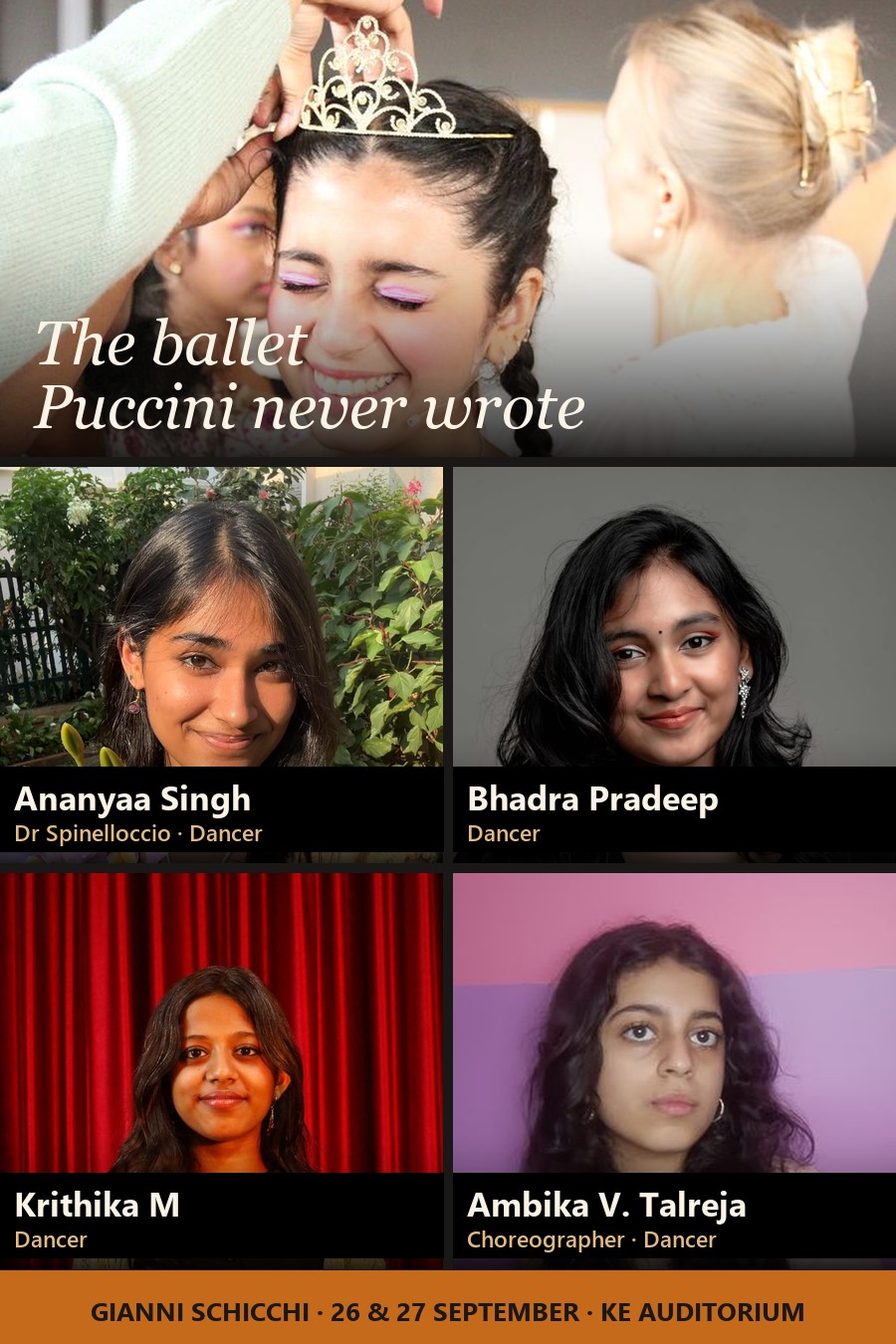
The Ballet Puccini Never Wrote
Why our Gianni Schicchi has dancers Puccini never scored, why we sing it in English, and what a comedy with a dead man in the middle asks of the stage.

Backstage 02: Natalla Marozava, vocal coach
Vocal coach Natalla Marozava on choosing an opera to fit the voices you have, teaching by ear, and why Puccini's comedy is sung in English.
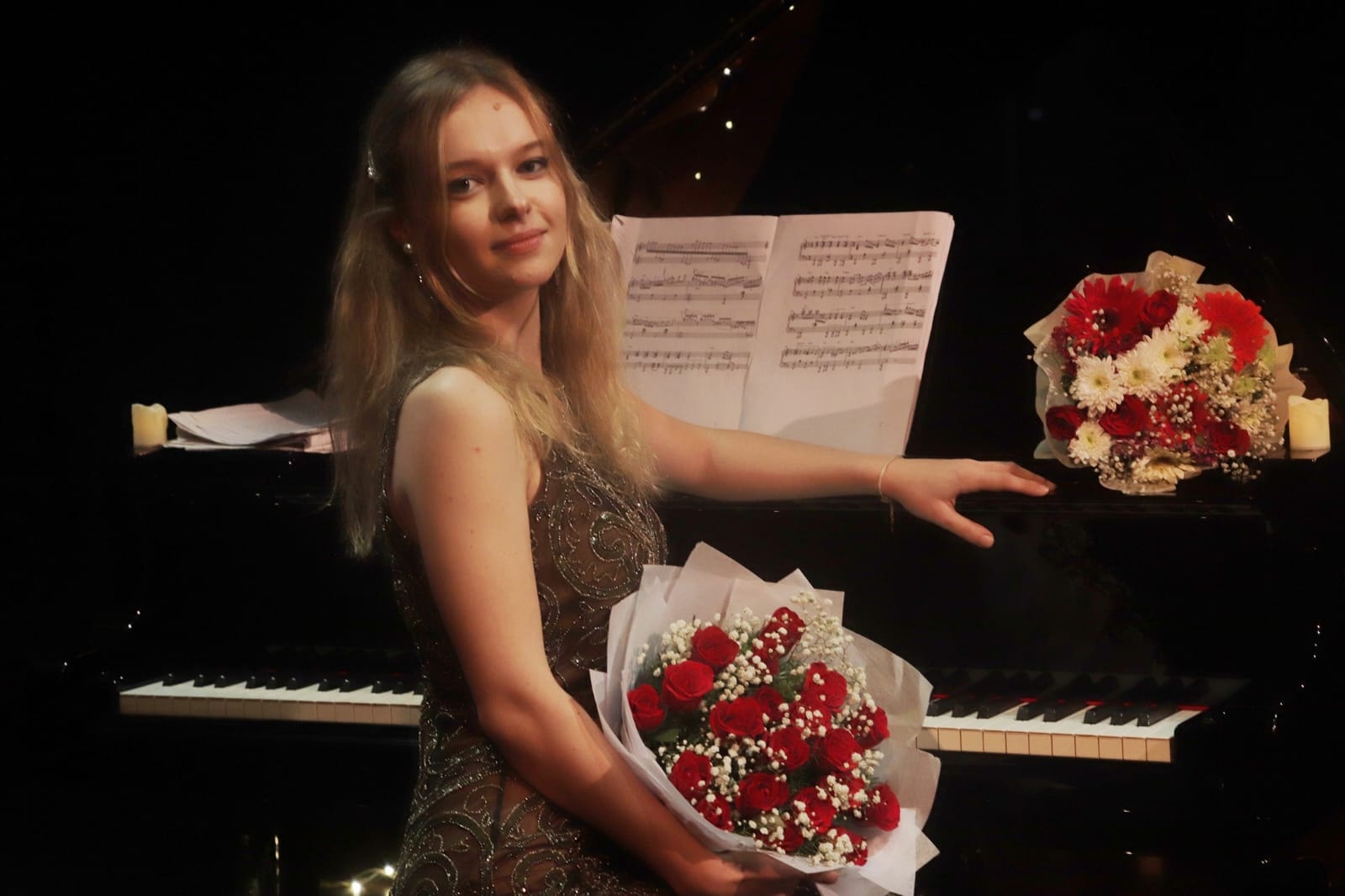
Backstage 01: Anastasiya Yafimava, répétiteur
At the piano with répétiteur Anastasiya Yafimava — conducting with her eyes and making one piano sound like Puccini's orchestra.
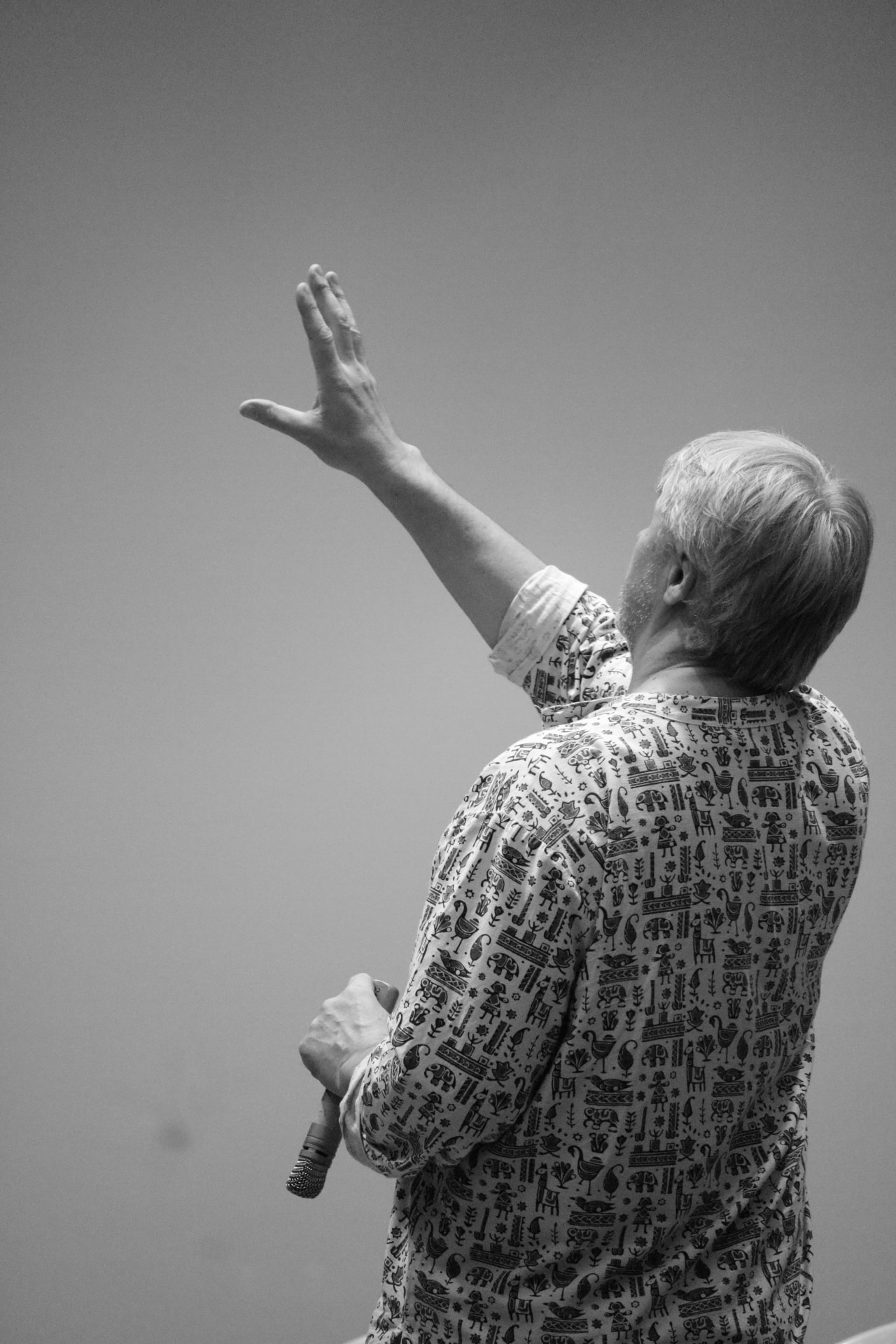
Backstage at Gianni Schicchi
Meet the singers, pianist, dancers and backstage team creating Gianni Schicchi at CHRIST University, Bengaluru, ahead of the performances on 26 and 27 September.